


“I still get nervous every time,” the cameraman tells me. “It’s live television.”
It’s week eight of Dana White’s Contender Series, and while I wait for Dana to come out and sign a card, I’m sitting next to a man with an apparatus slung over his back: wires running from a battery pack to the camera in his hands, antennae poking up over his shoulder. I’d asked if he was nervous his first time filming a live broadcast.
His answer transports me to a place I haven’t been in twenty years. My body is perpendicular to the ground. I have a harness around my waist, my feet pressed against the wall, and rope between my hands. I’m also fifty feet off the ground.
“Are you nervous?” the drill sergeant asks me as he peers over the edge from where he’s perched.
“Yes,” I say, and then kick off.
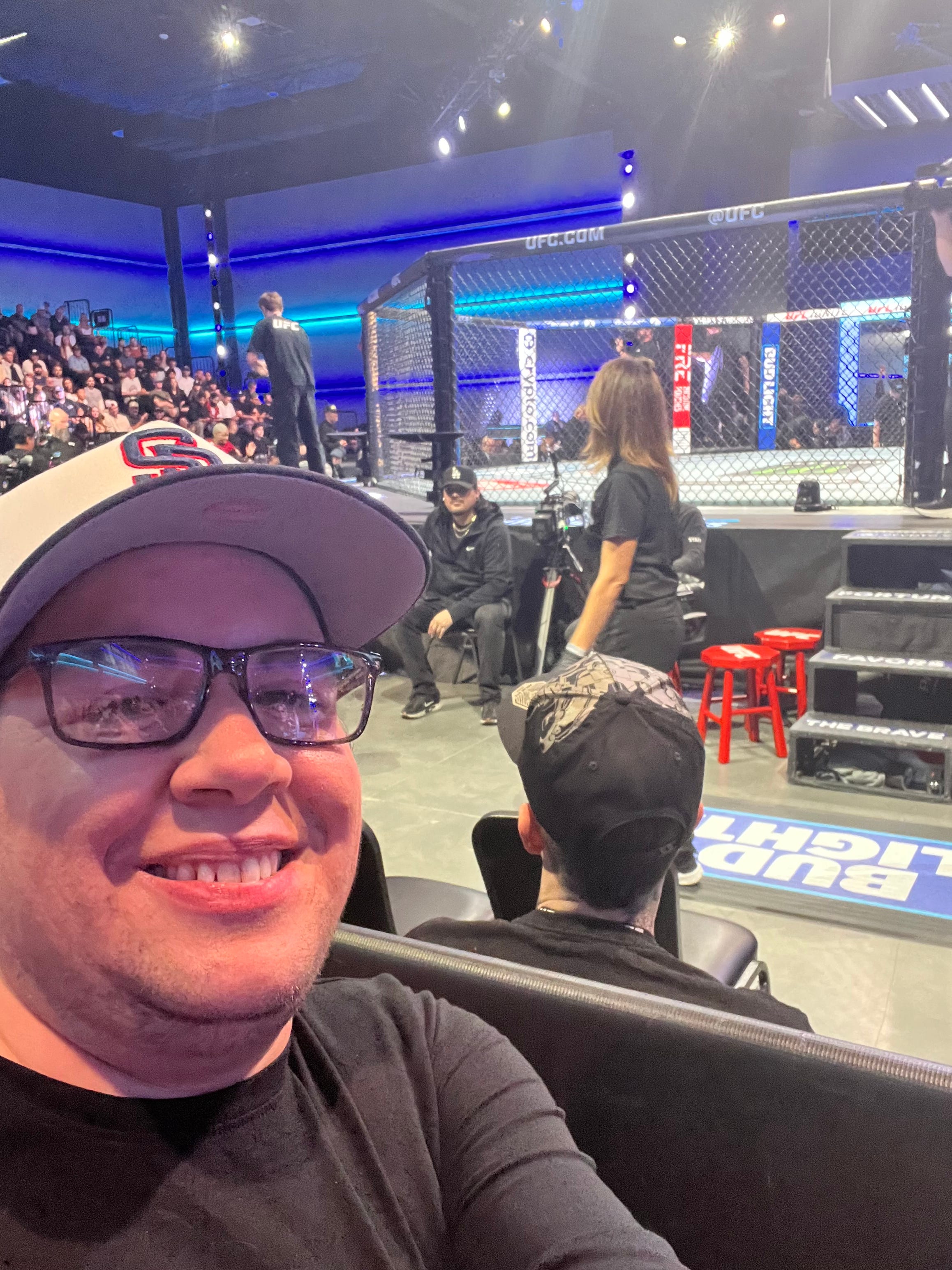
Then I’m back in my seat next to the cameraman.
During a recent livestream, someone asked Luke Thomas how to deal with the nerves that come with doing something frightening. His answer was the philosophy I’ve always lived by: you just do it. We kept talking about it in his Substack chat afterward. There are points in life where something scares the shit out of you, and you do it anyway.
I never expected to feel solidarity with a camera operator at the UFC Meta Apex. I had assumed that with practice came confidence and the erasure of fear. Yet here was a man who still worries about fucking up in front of thousands of live viewers. I’d only ever seen a figure in black, one part of the flawless machine that is UFC production. Some people don’t even see that.
“Have you ever actually tripped while filming and walking backward?” I ask.
“I have,” he says. “Thankfully, not on this show!”
Anyone who’s seen Dana tear into the crew for botching a VIP’s name can imagine the fallout.
Which leads me to ask, “Can you imagine? You’re walking backward, filming the fighter walkout, and suddenly the person on the other end of the TV just sees…” We both act it out at the same time. I hold up a hand like a mime and tip it backward. He flails his arms like he’s falling and makes a dramatic splat noise.
Then we laugh.
“This is the loop your assistant holds onto to make sure that doesn’t happen, right?” I ask, tapping a metal hook on his back. He confirms.
Minutes later, I’m in my seat. Cutman Brad Tate has a camera trained on him for test footage. He shadowboxes for it, playing the part perfectly. Then the swinging doors to my left pop open with a slam. Cornermen shout encouragement, the stands erupt as the fighter walks out, and the cameraman comes into view, walking swiftly backward, camera on the fighter, his assistant’s hand on his back as the group makes its way to the cage.
Everyone at home, and most of the 1,200 people in the building, saw what they were meant to see: perfection so complete that no one’s nerves came through the screen or into the room. The only experience that translates is that of the fighter about to face the gauntlet. The fighter’s nerves are part of the spectacle. The cameraman’s are something the spectacle depends on us never noticing.
I’ve written before about how the Apex’s small scale and the UFC’s high production caliber combine to deliver a one-of-a-kind visual experience that scales across their product line, no matter how large the venue. You’d think seeing the machinery up close would demystify it and make it ordinary. Once you know how the trick works, the magic fades, right?
It did the exact opposite for me.
It revealed another layer beneath the spectacle, one just as fascinating as the spectacle itself. The more I discovered about the people and processes that brought it all to life, the more I wanted to know.
How many people notice that the cutmen tag-team a fighter’s walkout? When I asked Tate on Instagram why they do that, he said it was to make sure the fighter’s team wasn’t putting anything on the fighter’s back. It traces back to “Greasegate” at UFC 94, when Georges St-Pierre’s coach Phil Nurse rubbed leftover Vaseline from his hands onto GSP’s back, shoulders, and chest. Officials caught it and wiped him down, but grease like that makes a fighter harder to grapple, which is why it’s banned.
You can see the cutmen directing the fighter who approaches the cage: hug your team, drink your water, then step back. One cutman watches closely as the other applies Vaseline to the face, checks the hair, gloves, and trunks for anything that doesn’t belong there, and then ensures they have their mouthguard. Then there’s one more threshold the contender has to cross: walking up the steps to the Octagon.
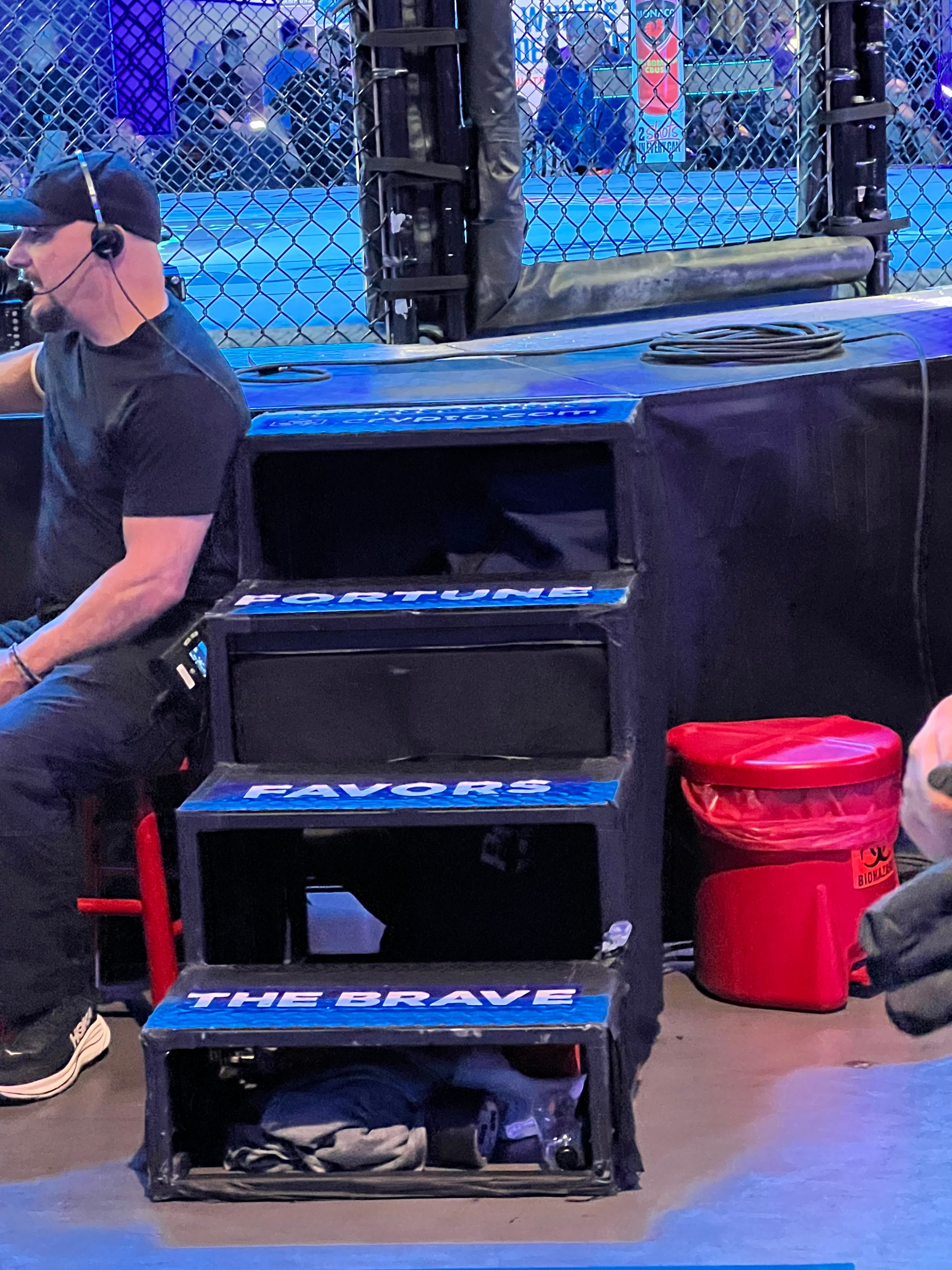
Every fighter at the Apex has to climb these steps and the words carved into them:
“Fortune Favors the Brave.”
If those steps could hand them the courage they need, they’d take it.
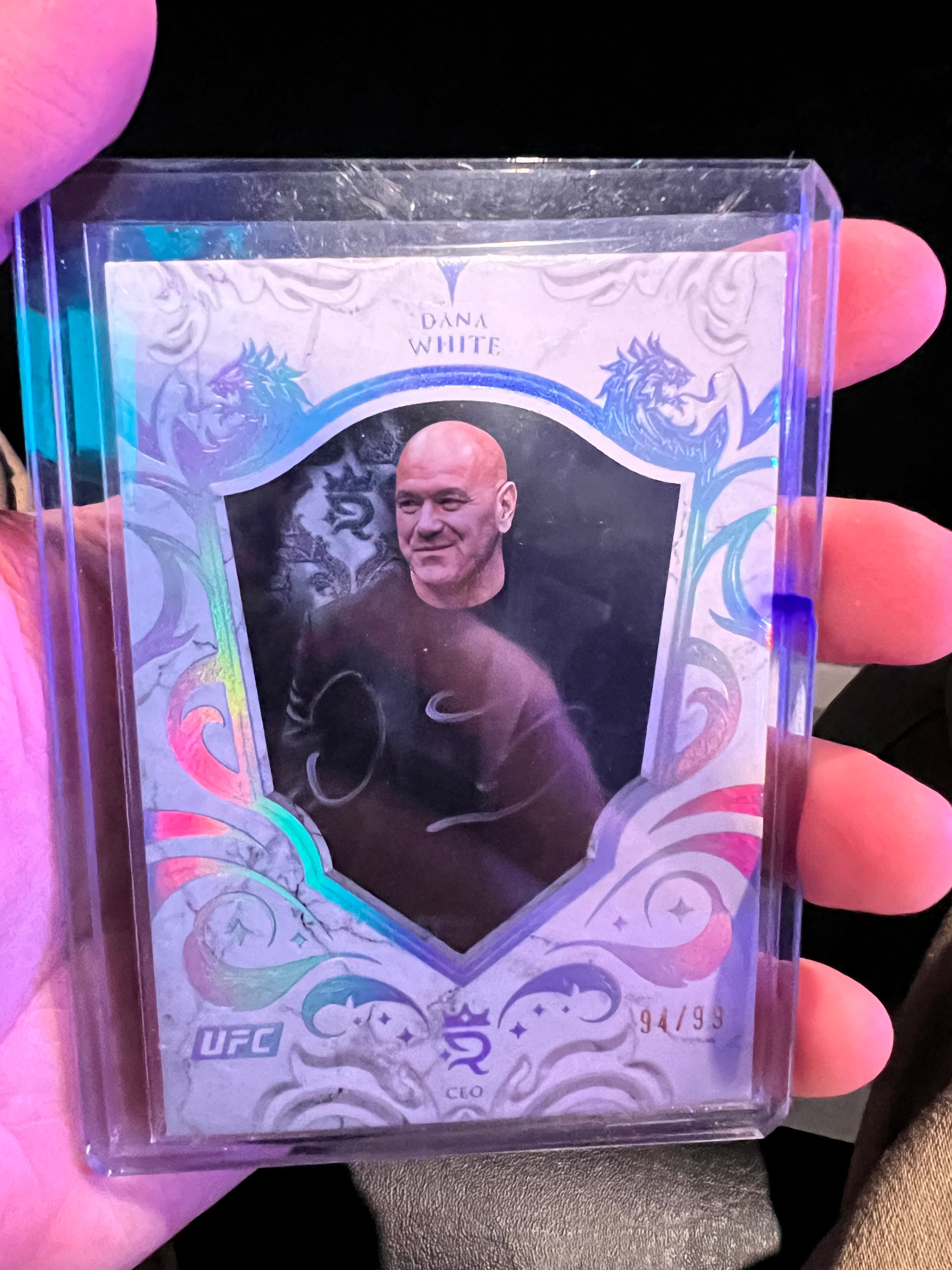
Week eight is truncated due to a dropped match, and Dana is noticeably late to the Octagon, which is how I ended up with time to chat with the cameraman. I also learned that his camera lasts two hours and that he carries spare battery packs in his backpack-like mount. When Dana finally comes out, the cameraman is long gone, and Dana is happy to sign my Topps UFC Royalty card.
“So, are we getting another Hunter card?” I ask, one card collector to another. He doesn’t reply.
“Were you talking into his deaf ear?” a friend later asks me. Shit, was I? I google “Dana White deaf ear” and find out that, yes, I was. That also explains the strange look he gave me the time I complimented his patience while my friend took a photo with him. I’d been talking into his left ear.
I shrug.
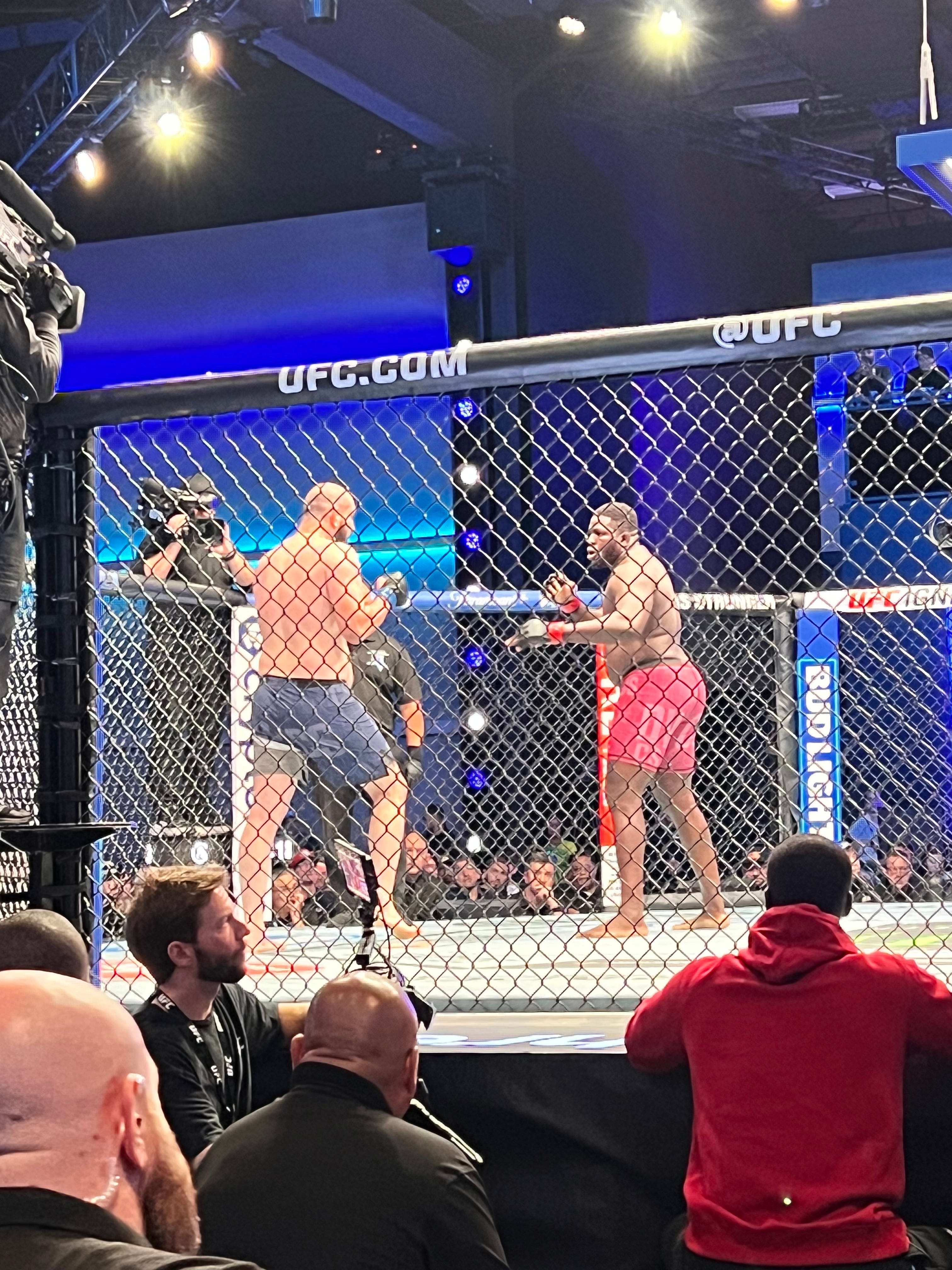
Later, in my chair in the stands, I watch the first fight end with an inverted d’Arce choke as Brazilian flyweight Aieza Bertolso takes home the win and, later, the contract for her first-round submission.
“Vamo, Peru!” someone calls out next to me during the next match as featherweight Ian Escuza ends his fight with knees and punches in the first round. The replay shows what we all saw: an illegal knee to the head of a downed fighter. Later, a viral clip circulates on X and Instagram of Hunter Campbell behind the fence, throwing his hands up and looking over at Dana as the downed fighter eats the knee. The ref, Herb Dean, doesn’t catch it.
“Why is it always Herb Dean?” someone else next to me says. I grimace and laugh at the same time.
After the fight, Herb Dean goes over to where the four UFC heads sit and crouches low between Dana and Hunter, chatting with them about the fight.
The crowd cheers when Paddy the Baddy, Luke Riley, and Steve Aoki enter the building to support fellow Liverpudlian George Staines in the main matchup.
But first, there’s another contract on the line. Heavyweight Zaurbek Sabanov stamps his feet when he enters the Octagon. He’s put away in the second round by Adama Diop, who first takes a brutal knee from Sabanov before returning the favor with punches. Steve Aoki gawks at the action, his mouth dropped open into the shape of an “o.”
Earlier in the night, The Ultimate Fighter contender Xavier Franklin caught me grinning at him and held out a fist to mine. “What’s up, my man?” he said.
The lightweight main matchup has the crowd roaring. “Let’s go, Big Red!” someone screams. “He’s grabbing the cage!” another yells. “I love you, Herb!” a third man calls out. Staines lands a ground slam and punches to end the match in the first round, and Paddy Pimblett absolutely loses it. Hunter Campbell turns around to look at the blond Liverpudlian behind him and laughs at the sheer joy on his face. Later that night, a friend of mine takes his replica Freedom 250 White House UFC belt over to Paddy to get it signed. Paddy proudly scrawls his signature across Ilia Topuria’s face.
As Staines leaves the cage, proud and happy, the production crew raises their arms like air traffic controllers, guiding him to the back of the Apex, where his friends in nearby seats ambush him.
I manage one last conversation, with a female security guard working for the UFC. “We need to see more women in this kind of role,” I say. She agrees, mentioning the physical fitness test she had to pass to get the job. Really? I muse. I didn’t have to do anything of the sort when I pulled security in my earlier years. Then again, I was only guarding buildings, not keeping cage fighters in check.
Dana White gave a recent interview on The Diary of a CEO where he discusses his views on success and his own life. He has a relentless drive and never backs down from daily challenges or from going after the next big thing. I think about the steps into the Octagon that immortalize those words in the wood, so the bare feet of everyone brave enough to climb them tread on those words. For all Dana’s flaws, his constant forward momentum and desire to create and achieve embody them: “Fortune Favors the Brave.” I think about the cameraman, his nerves, and his ability to channel calm at the moment it matters most. I think about that day in boot camp when I had to face the 50-foot wall, despite my fear of heights. I think about Luke Thomas and his advice to the fight fan who just wanted to know how to get through the moments we all fear. The UFC Apex is where fighters, the lifeblood of the sport, spill their blood, sweat, and tears in search of a better life. It’s a place where you can feel the electric charge in the air: anticipation, nerves, and longing. I can’t think of a better place to be reminded that the only way through fear is forward.