


“Eight! Seven! Six!”
A man wearing a fedora and a headset is counting down loudly; two camera operators stand next to him, their cameras pointed at the door just to my left and behind me.
“Five! Four! Three!”
The house music has gone silent. The crowd hushes. The two cutmen stand still as statues – waiting.
When his count reaches one, the double doors at the end of the walkway swing open.
The first thing I see is a production crew member, his hand on a strap in the back of the camera operator’s vest, tethering them like a lifeline. The crew member strides toward the Octagon. A foot behind him, the camera operator matches his pace while walking backward, lens trained on the fighter following behind. The blue of the fighter’s shirt catches my eye through the bars to my left. He stares straight ahead, his expression fixed. A smattering of applause and a few whistles go up, but the prevailing sound is that of silence.
“Let’s go, Christian!” someone screams next to me. It’s louder because of the room’s small size and stillness. The cameras will pick up the shouted phrase on broadcast.
The fighter, Christian Natividad, yanks his shirt over his head. His corner catches up to him, and his brother, a UFC veteran, Kevin Natividad, pulls Christian in. Their foreheads press together for a long moment – long enough to draw chuckles from the crowd.
“That’s his brother,” someone explains before the moment ends and Christian turns to one of the two cutmen to receive his pre-fight application of Vaseline to the forehead and cheekbones. Then, he steps into the cage.
His opponent, Colton Loud, is a much taller redhead. Moments later, at 1:10 of the first round, Loud is doubled over in a fetal position at the center of the Octagon after Natividad lands two body shots in quick succession, the second a crushing left hook to the liver. The crowd erupts. Dana White stares into the cage and mouths, “Wow.” Beside him, Hunter Campbell turns toward White, raises an index finger, and speaks emphatically.
For the first time in its ten-season history, Dana White’s Contender Series is selling tickets to the public, and the presence of a paying crowd changes the atmosphere inside the Meta Apex. The largely silent walkouts of previous seasons now attract applause, whistles, and individual voices loud enough to be heard on the broadcast.
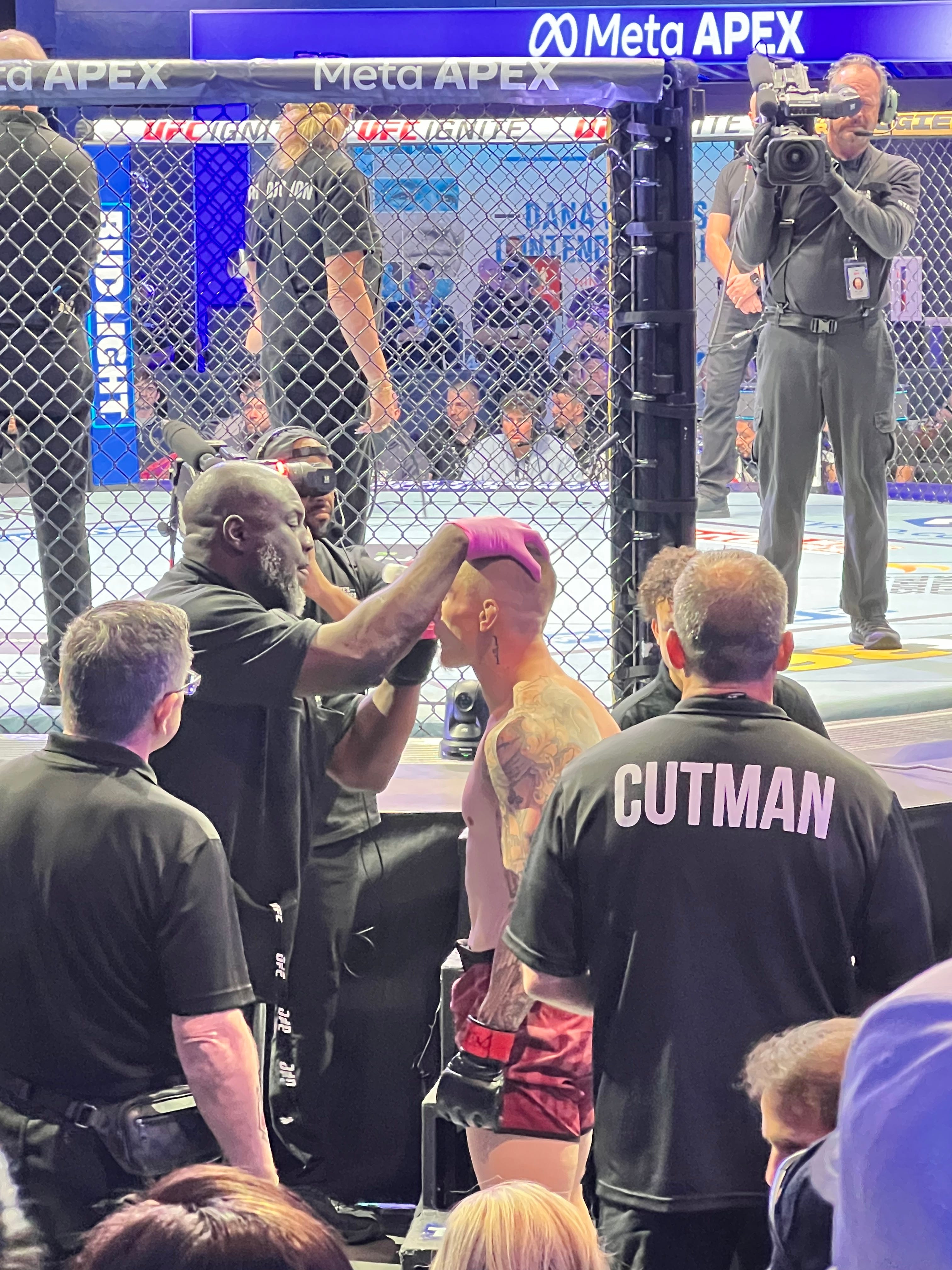
But attending the show also reveals another performance unfolding outside the cage: the carefully choreographed production required to make a live fight appear effortless on television. One spectator notices that the fighters receive neither walkout music nor a formal introduction.
“They’ve got to earn it,” another replies.
That is the premise of Contender Series. But while the fighters are trying to earn UFC contracts, dozens of people surrounding the cage are working to direct it.
For the third fight, Martin Kozak hit Christian Echols with what looked like a body shot at the end of the first round, doubling him over. The crowd cheered until the blow was revealed to be low, then booed, shouted “cheater,” and chanted, “take a point!” Kozak turned their boos into cheers when he stopped Echols with strikes at 1:32 of the second round. The most impressive contender was Quentin Pasley, who headlined the show, defeating Arlind Berisha with a KO at 4:41 of the first round. “That guy fought like Jon Jones,” one man behind me said. Dana White would later say that Pasley had “shades of Jon Jones” when awarding him a contract after the final bout
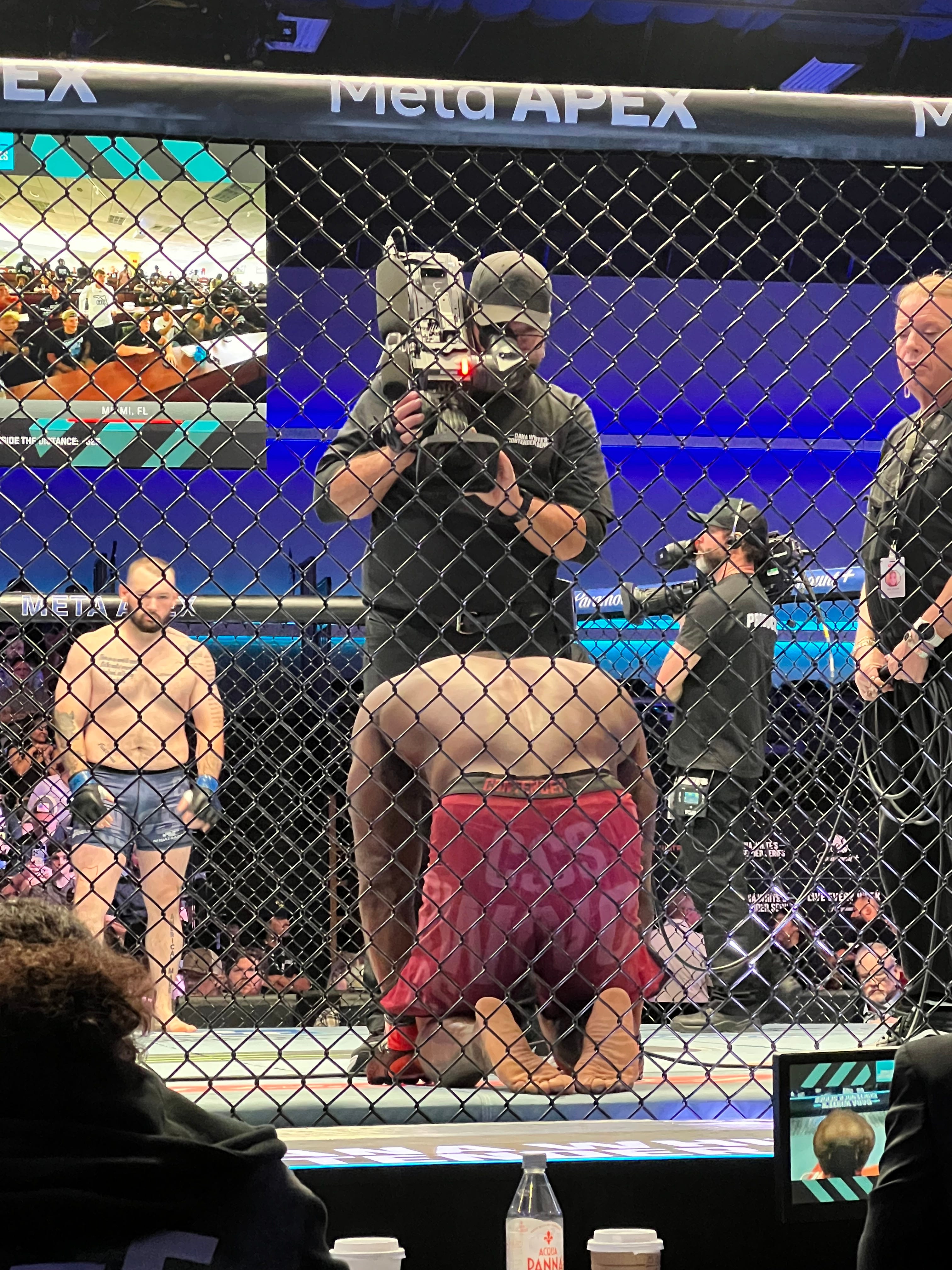
The television broadcast is carefully crafted for viewers. Dana White has been known to be a big stickler for production excellence. Court testimony from earlier this year by Hunter Campbell revealed that Dana is “completely obsessed with production and how the product looks,” while Hunter is the one running the fight business. Just look at the spectacle of UFC Freedom 250. Its production was undeniably spectacular.
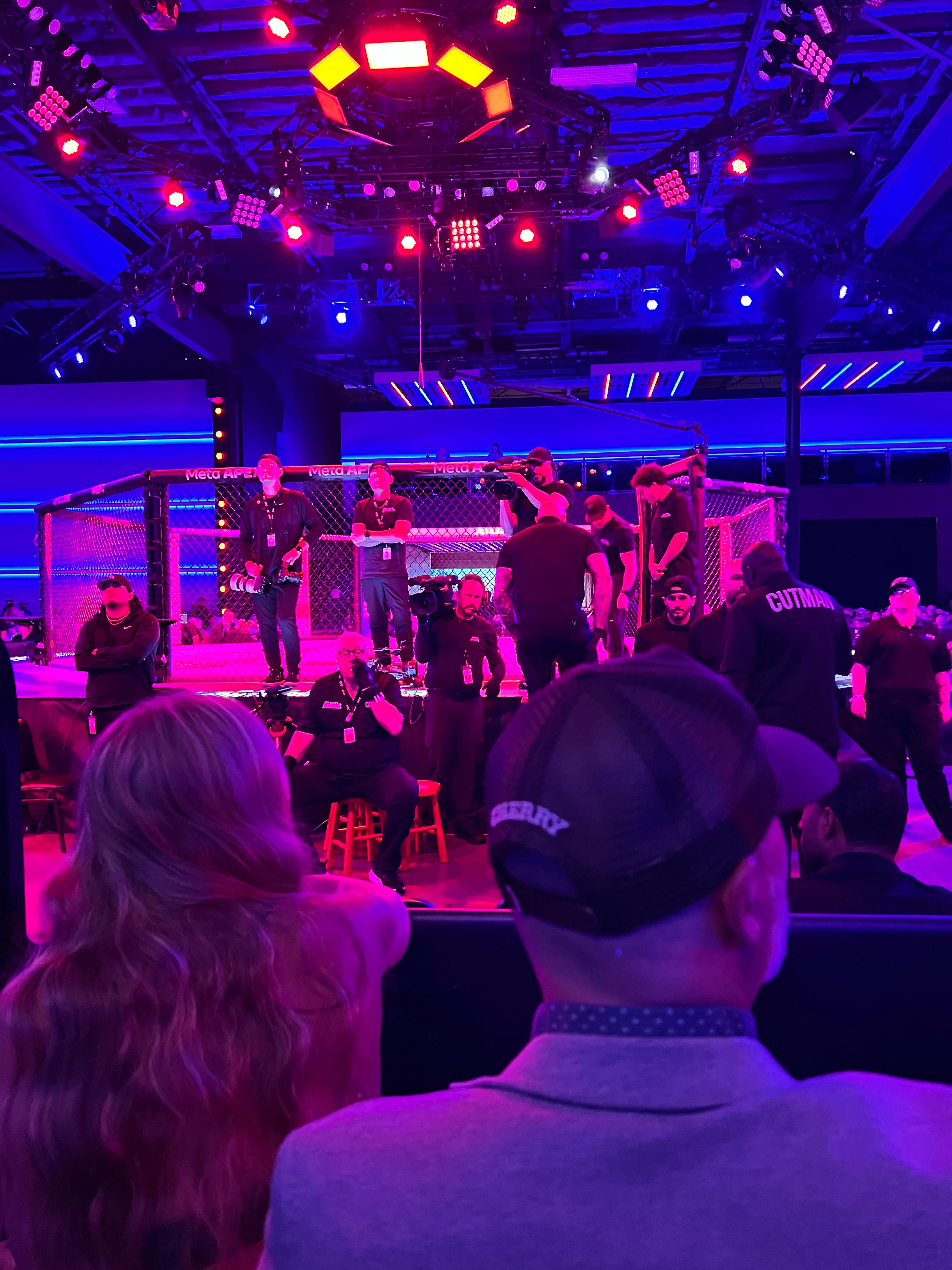
While the majority of the audience at the Apex focuses on the fighters and the fights, I couldn’t help but be drawn to the other “show” going on around me across the roughly dozen times I have attended there. I’ve been so caught up in what the production crew is doing that I have missed major KOs multiple times.
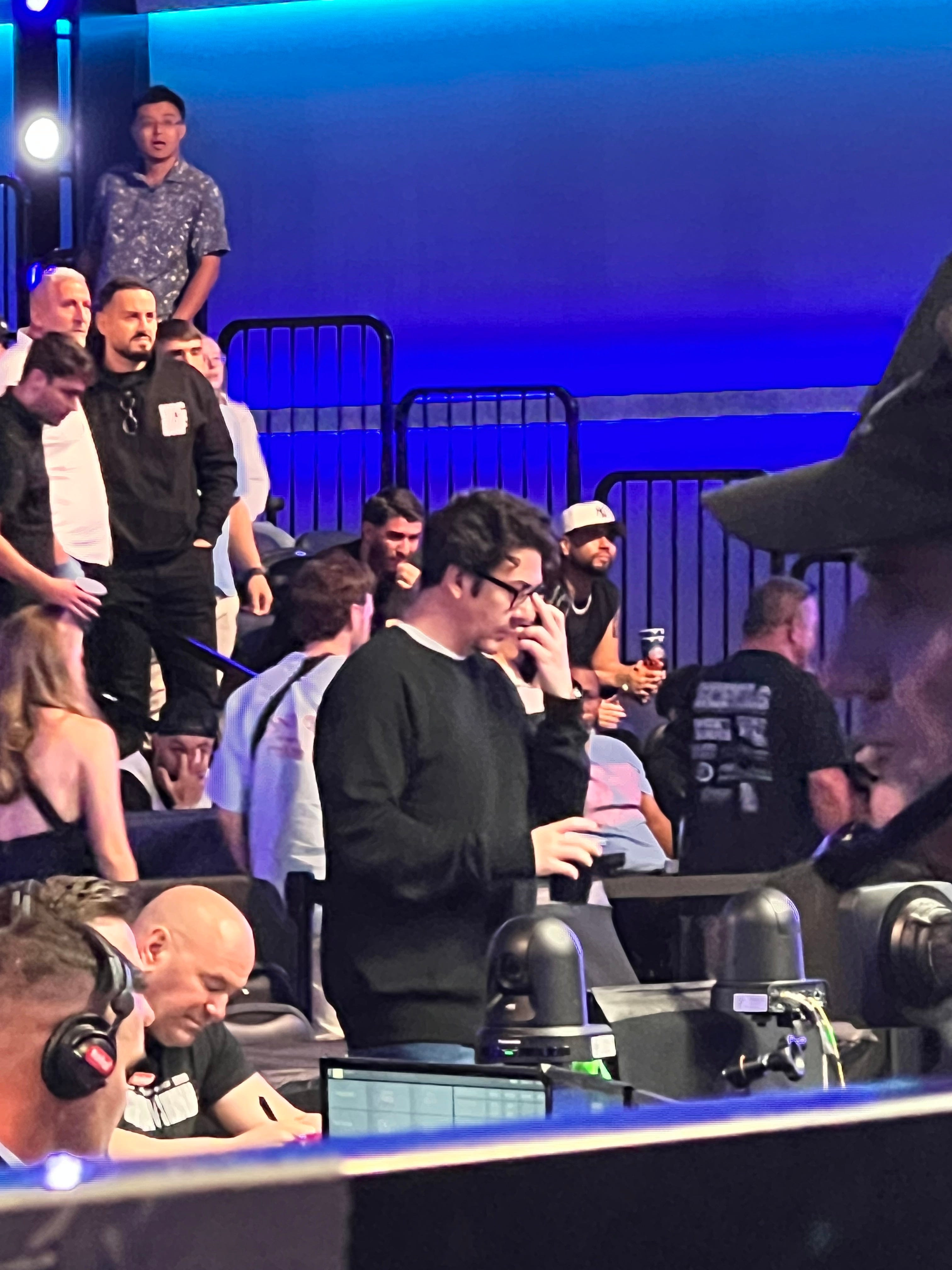
The camera operators rarely remain in one place. Their movement resembles a carefully orchestrated ballet that occasionally looks like chaos. Two cover the fighter walkouts. During the bouts, three more occupy small platforms extending from the Octagon posts. Another circles the cage at floor level, shooting through the chain-link fence. An assistant follows, feeding and gathering the thick cable attached to the shoulder-mounted camera so it neither snags nor restricts the operator’s movement. One unseen operator pilots a boom-mounted camera that swings 360 degrees, both over the crowd and into the Octagon.
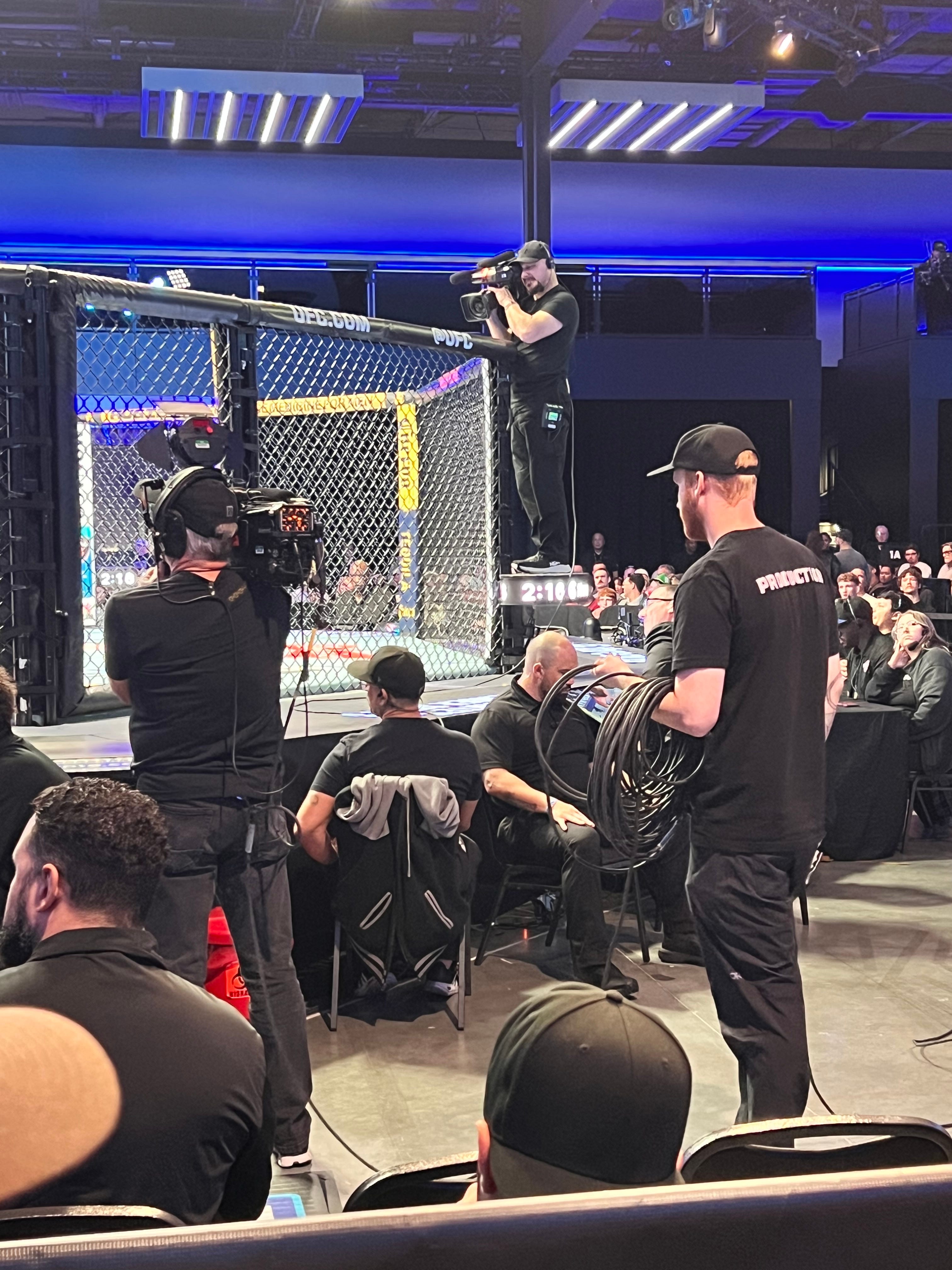
Around them, a half-dozen photographers, each carrying lenses nearly the length of my forearm, move from position to position, capturing still images while trying to remain invisible to the broadcast cameras. One of them perches on an unoccupied cage platform during bouts, shooting down over the edge of the fence. Another two drape across the rail of the new Mezzanine area, getting a bird’s-eye view of the cage.
One crew member appears to be responsible for Daniel Cormier’s chair. When a knockout sends Cormier to his feet, the man restores the chair to position. When Cormier prepares to enter the cage for the post-fight interview, he helps him into his suit jacket and threads an earpiece cable through his collar, connecting him to an unseen communications system.
DC’s chair guy, if you’re reading this, please contact me. I have an unreasonable number of highly specific questions about your job.
Mixed among the production crew is another layer of personnel responsible for making the contests official and safe: the Nevada Athletic Commission officials who sanction and oversee the event. I’ve seen the same people over time – judges, referees, commission inspectors, ringside physicians, timekeepers, and the executive director.
Mike Beltran had the honor of reffing the final bout, and as he came out of the cage, he stripped off his latex gloves and threw them into a red medical waste bin next to the Octagon stairs. After he did this, he pulled his long beard, tied into twin tails, out from under his shirt with a flourish. My eyes narrowed as I made a mental note: ask Mike Beltran why he has to tuck his beard in Nevada for UFC events but not in California for amateur promotions (I previously saw him at UNF 35 and EPIC 65–both in SoCal).
The ring announcer is licensed by the commission but paid by the promotion. At most Apex events, that voice belongs to Justin Bernard, a longtime Tuff-N-Uff announcer who began working with the promotion in 2010. Bernard told me the UFC has steadily expanded his responsibilities. He now serves as the dedicated announcer for Apex cards, including UFC BJJ, and also works Road to UFC and Power Slap. He recently appeared at UFC Fight Night in China. When I asked whether an announcers’ union helped distribute assignments, Bernard said his opportunities had come through networking and hard work. Justin, who has become one of my favorite announcers, is incredibly humble in person. When he asked if I was an announcer, I laughed and said no. Journalism is, in fact, the most I want to expose myself to the public. We then agreed that UFC BJJ seemed like the optimal gig, since he gets to sit behind the desk and announce for the majority of the show, aside from title matches.
The promotion supplies still more personnel: ring card attendants (or ring girls to you sickos, although I am campaigning for ring boys too), matchmakers like Shelby and Maynard, security, and EMTs stationed off to the side with an ambulance and gurneys ready.
Campbell’s position beside White is new this season. In previous seasons, matchmakers Sean Shelby and Mick Maynard flanked White while Campbell occupied the far end of the table. Through the first five episodes of Season 10, White has instead sat on the left end, with Campbell directly beside him, followed by Shelby and Maynard. Campbell repeatedly turns toward White during the fights’ biggest moments.
On Contender Series, the arrangement matters. The broadcast frequently cuts away from the cage to show the executives’ reactions as they evaluate each fighter for a contract. Moving Campbell into the seat closest to White places him more visibly at the center of that decision-making process, an arrangement consistent with his increased authority over the UFC’s fight business.
Campbell attends virtually every UFC card and, according to his recent court testimony, runs the promotion’s fight business. His responsibilities extend far beyond what happens during the broadcast. Fight Inc. documented Campbell managing last-minute withdrawals and other crises, while fighters increasingly acknowledge him after bouts as the executive responsible for making fights and advancing careers (Just don’t bark at him—please, Im begging you). For now, at Contender Series, he remains beside White, watching prospects attempt to earn their way into the organization he increasingly runs.
After the contracts had been awarded and the broadcast ended, Dana White and the other three members of his “War Room” crew—Hunter Campbell, Sean Shelby, and Mick Maynard—stood and began to exit. Pathside, a man stood with a belt in a velvet carrying case over his shoulder. Earlier that night, I asked him about it, and he replied it was one of the limited-run Freedom 250 replica belts. He had Diego Lopes sign it on a prior Contender Series night (I’ve spotted Diego each week so far) and hoped to have Dana sign it, too.
“Why stop there?” I asked. “Have Hunter, Sean, and Mick sign it, too.”
“Who are they?” he asked.
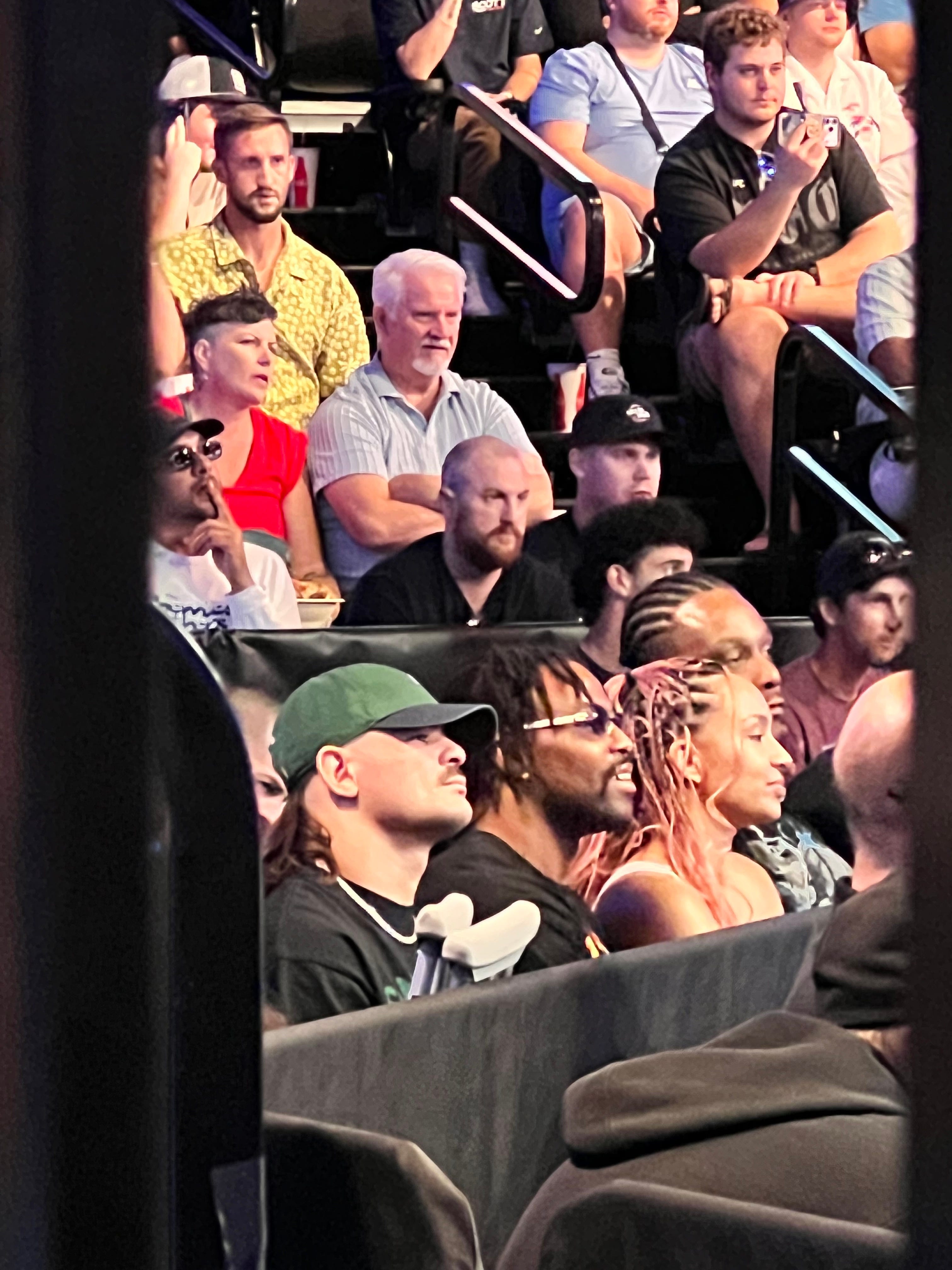
It was a useful reminder. Most UFC fans know Dana White, whose fame has eclipsed that of many fighters. The executives and workers surrounding him remain largely invisible, even when they are sitting only a few feet away. At $25, Contender Series tickets have opened the newly expanded Meta Apex to fans who previously might never have considered attending. From these seats, there are no arena nosebleeds and little distance between the audience, the fighters and the people making the broadcast happen. The UFC’s machinery is not entirely exposed, but it is more visible here than at any arena show. I will be at UFC 331 in Los Angeles. But given the choice between watching from the upper reaches of an arena and sitting close enough to hear a crew member count down a fighter’s entrance, I know which version of MMA I prefer.