


The first thing you notice walking into the main chamber of the now-rebranded Meta Apex for a UFC BJJ event is the giant cereal bowl sitting in the middle of the room.
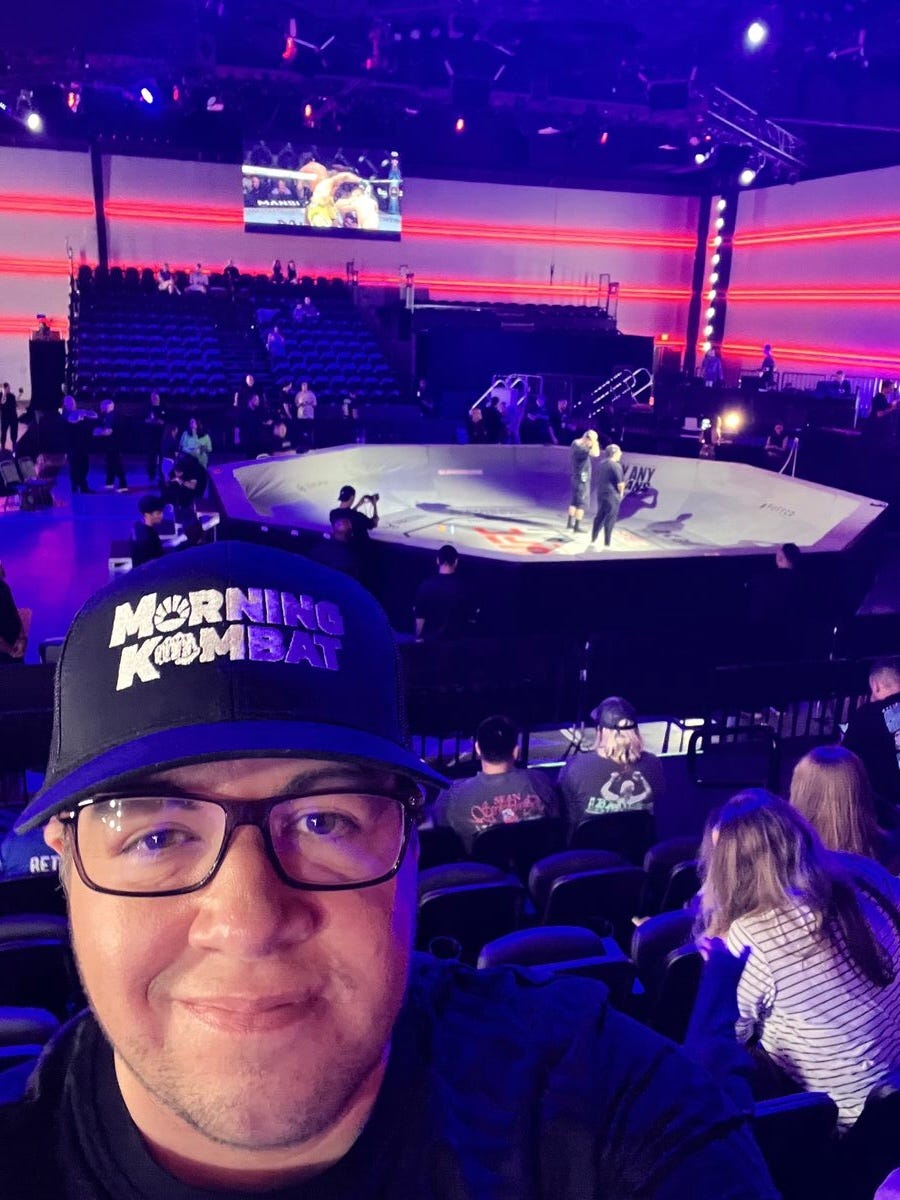
I kid.
I know little-to-nothing about Brazilian Jiu-Jitsu, and what I do know comes exclusively from watching the UFC and other MMA promotions. So I had no idea what to expect when I arrived at the UFC Apex for UFC BJJ 10.
What I do know is that the ring is not a cereal bowl. The sloped-wall Pit design was first pioneered by Karate Combat, who used a square version, and then adopted by the Craig Jones Invitational (CJI). The UFC’s version, though, is octagon-shaped, since the UFC holds exclusive rights to the octagon shape in fighting enclosures. That’s what gives the Pit its distinctive UFC look and flair, no matter what combat sport is taking place inside it.
I’ve been to the UFC Apex countless times since it opened to public access, both for the Las Vegas Fight Night series and, more recently, Dana White’s Contender Series. But UFC BJJ was new to me, and I wasn’t sure what to expect walking in. The entryway and lobby were unchanged: same security process, same slightly-altered lobby. The first real difference wasn’t architectural, but the tickets themselves. Instead of assigned seating, UFC BJJ was General Admission, priced $45.00–$56.72 after fees. I had no trouble grabbing a ticket last minute, and I don’t think the event even sold out.
Then came the first change I noticed inside the Apex itself. Instead of walking straight into the main chamber, guests were funneled to line up on each side of the lobby, then led in behind the bleachers before emerging to pick their seats. Unlike MMA, there’s a reason to sit further back here: higher seats give a better view down into the recessed bowl at the center of the space. Still, seats weren’t hotly contested despite the general admission format, and I had no trouble finding a prime spot. A source inside the Apex put attendance at approximately 500 guests. The crowd itself felt different from a typical Apex fight night: far more children, more families, and more hardcore BJJ fans. Guys in front of me wore fight gear branded with the Pride logo and cheered for specific fighters they seemed to know personally, while the couple behind me discussed BJJ technique with the kind of detail that suggested they trained themselves.
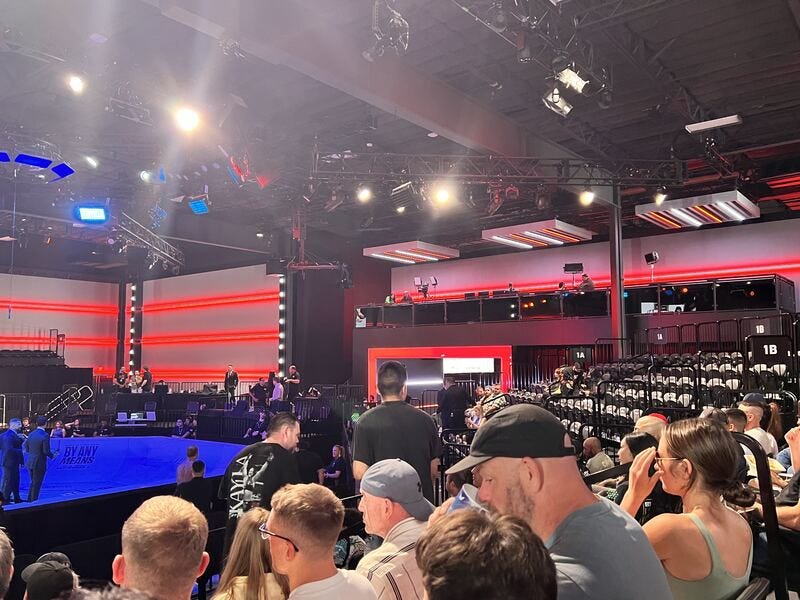
A number of things were different for the event. A desk for announcer Justin Bernard and other officials sat on a raised platform to the right of the ring, while the Mezzanine level was used for post-fight interviews and the VIP room above held commentators on camera. Camera crews, photographers, and videographers surrounded the Pit, one of the real spectacles of being at the Apex for a live TV broadcast (in this case, UFC BJJ streamed on YouTube). The Pit featured ads from the likes of Palantir and Turning Point USA, continuing the UFC’s recent embrace of more overtly political and ideologically aligned branding. Michael Chiesa and Din Thomas opened the show on camera, standing in the middle of the Pit. I half-expected some booing directed at Thomas given the recency of the Gillian Anderson situation, but none came.
I found myself wondering how much effort it took to break down the Octagon and swap in the Pit (or, as the UFC did for Adin Ross’s Brand Risk promotion, a boxing ring). I wondered too where they stored the Octagon pieces and how long the changeover took. Given the engineering feat of erecting the “Dome” at Freedom 250 in front of the White House, this looked easy by comparison. The UFC clearly prides itself on this kind of production.
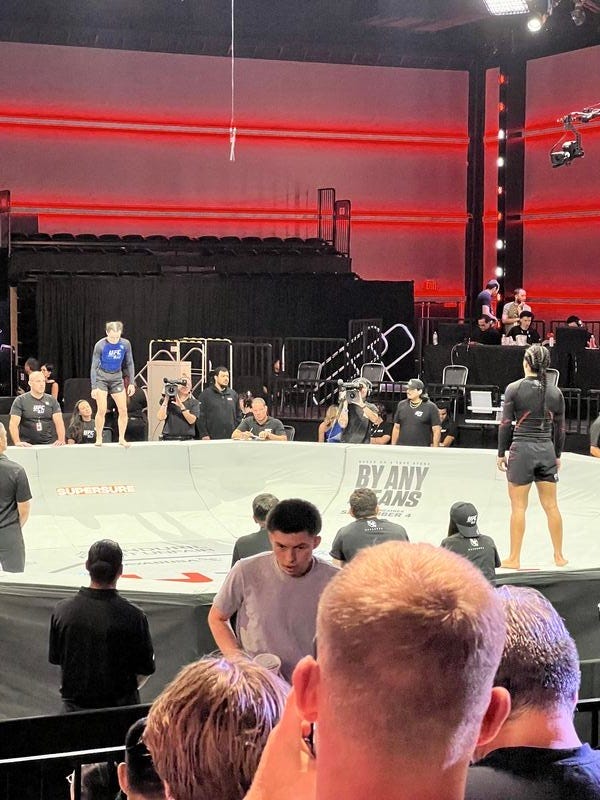
The grappler walkouts played out much like they do in MMA, except grapplers climbed a short flight of stairs to the top lip of the Pit, then walked its edge to reach their corners. Announcer Justin Bernard didn’t step into the ring for introductions, staying at his desk instead. Four camera operators stood at each corner filming, while several people sat Pit-side, two of them with notebooks and pens in hand.
When it was time to start, the competitors ran down into the Pit and began to grapple. One thing was clear from the first bout: grapplers used the sloped wall constantly, running opponents into it to build momentum for takedowns. In the opening match, Kelly pushed Lima onto her back against the top ledge, and the ref made them reset in the middle. There was also a clear emphasis on finishing fights, same as in MMA, and there were plenty of finishes that night. The crowd came alive whenever a submission attempt started, but nothing that night was louder than the end-of-round horn. That thing was ear-splitting loud.
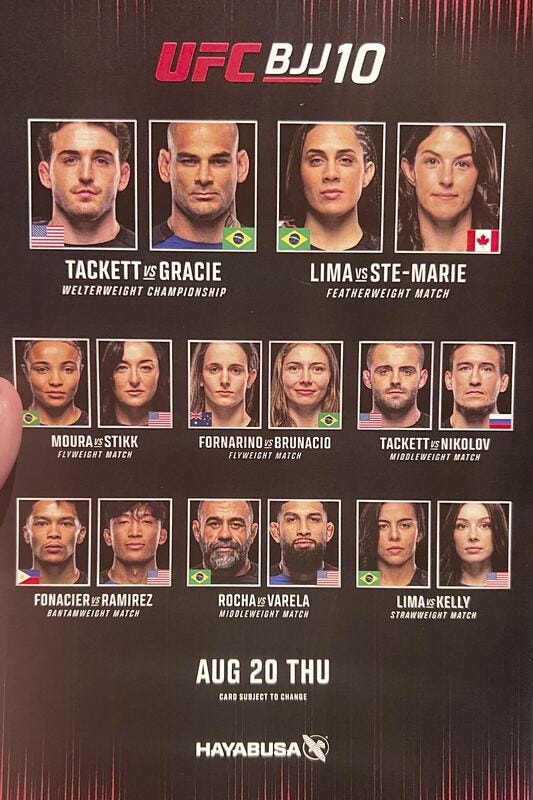
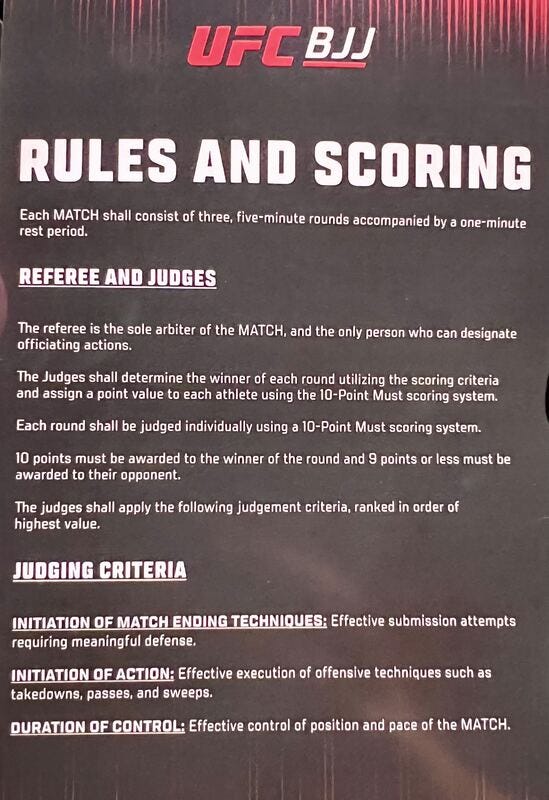
The first match ended with both strawweights, Lima and Kelly, tangled in dueling heel hook attempts, the two of them rolling like some interlocking worm until the horn sounded. Kelly was the more aggressive grappler and got the decision. She perched on the edge of the Pit for her post-fight interview. I still didn’t understand how BJJ was scored, but the fight cards handed out at the door had the rules printed on the back: 10-point scoring rounds like MMA, three rounds total, with points awarded for match-ending techniques, initiating the action, and duration of control. I wondered how the rest of the card would play out. Would the lack of striking and ground-and-pound bore me? Would I want to leave before the main event? The decision win in the opener didn’t give me much to go on, but that was about to change.
Middleweights Rocha and Varela came out next. Rocha paused to pray at the edge of the Pit, something I’ve often seen MMA fighters do before entering the cage. Varela, surprisingly, had a female coach in his corner, something you rarely see with male MMA fighters. Jason Herzog reffed the bout, and the two men spent noticeably more time on their feet, fighting for position, before Varela took an accidental eye poke. When one fighter drove the other into the edge of the Pit, production and coaching crew at the rail pushed them back in, the same way people at the edge of a mosh pit shove wild dancers back toward the middle. Varela ultimately submitted Rocha with a crescent choke in the third, in a genuinely competitive match. I had to turn around and ask the clearly knowledgeable woman behind me what the move was called; I don’t remember ever seeing it in MMA. Varela said afterward he’d tried the crescent choke many times before, and this was the first time it ever worked. There’s a first time for everything.
Bantamweights Fonacier and Ramirez fought next. Ramirez nearly sank a rear-naked choke at the end of the first round, but the fight went the distance, with Fonacier getting the decision.
William Tackett’s entrance brought a huge pop from the crowd. I’d been told beforehand that the Tacketts were good, so I knew to watch for them, but I wasn’t prepared for just how good. With his brother Andrew in his corner, William and his opponent Nikolav both survived the first round. Andrew fanned William with a towel between rounds, and William came out and got a heel hook in the second. Who knew BJJ could be this fun? On his way out, a little girl ran up to the barrier begging Andrew for a picture, and another fan asked for his shirt. These guys were BJJ superstars.
The card kept moving. Fornarino got a straight ankle lock sub over Brunacio in the first round of the women’s flyweight bout; the winner climbed the edge of the Pit and the crew switched on big bar lights for her interview. A lot of the grappler intros leaned into religious themes, a common thread in combat sports generally. Moura followed with a first-round armbar sub, then climbed the stairs to the Mezzanine after her Pit-side interview to appear on camera again.
Next up was Brianna Ste-Marie, known as “BSM,” who got a head-and-arm choke in the second. “Yes, Bri!” her coach shouted from the corner. The co-main was a title fight, and a woman climbed into the Pit to award the belt afterward. The interviewer climbed in too, along with two cameramen, for the winner’s interview. When it wrapped, one cameraman set his camera on the lip of the Pit, took a running start, and sprinted up the sloped wall to retrieve it. The same fan who’d gotten his shirt signed by William Tackett was waiting at the edge of the walkout path; he reached over and shook Brianna’s hand. When he pulled back, his buddy was there to congratulate him, grinning ear-to-ear, face red.
After seeing William fight, I had a sense of how Andrew Tackett might perform in his main event against Jonnatas Gracie (whether he was actually part of the famous Gracie family, I couldn’t confirm), but I still wasn’t prepared. Andrew came out with swagger, medium-length hair swept back to perfection; I could already see why he was the main event. As he marched down the walkout path, a cameraman ran backward ahead of him, tethered by a loop on his back to an assistant pulling him along. Once the fight started, Andrew was immediately aggressive, driving Jonnatas into the wall for a takedown before the fight hit the ground. He sank in a rear-naked choke and made it look easy. The crowd went wild. Andrew was awarded the belt and called out Sean Brady and Paddy Pimblett, two UFC MMA names I’d genuinely like to see him fight.
I left the Apex satisfied with my first BJJ event. Going in, I had my doubts about the sport’s “excitement factor”; I’d once clicked on a free UFC BJJ stream on YouTube and turned it off within minutes. But live BJJ, like live MMA, is a different animal entirely from watching it on a screen, and I’m glad I saw it in person. I might even go to the next one. Musumeci has become a favorite of mine in the sport, and if the UFC can bring enough star power in front of the camera and keep pushing for finishes, I could see this thing going the distance.
Until next time.
Upcoming reporting will detail events like Tuff-N-Uff 156, EPIC 66, and Up Next Fighting 35.
Updated September 4, 2026: tightened for clarity and flow, and added a detail about ringside advertising in the Pit.
Updated September 5, 2026: clarified terms preferred in BJJ vs MMA.