


Featherweight Imran Mohammadi picks up Trevino Roberts, carries him across the cage, and slams him hard onto the mat to a chorus of “oohs” from the crowd. A hail of blows from the mounted position ends it in the second round, giving Mohammadi his first amateur win.
Moments later, the referee steps out of the cage and strips the black latex gloves from his hands, sending a spray of sweat everywhere like a sprinkler. He drops the soaked gloves and kicks them unceremoniously under his side of the cageside table. A man in the crowd gawks and elbows his friend to point out the torrent the gloves produced.
It’s just after 6 p.m. on Friday, September 25, 2026, poolside at the Sahara Las Vegas for Tuff-N-Uff 157. It’s 92 degrees, but the temperature has already started dropping as shadows from the tall buildings on all four sides close in. The air feels sticky and heavy. The fighters’ bodies gleam as they take to the cage.
I’m sitting cageside, close enough to hear the corners’ instructions and talk to the officials between bouts. Throughout the evening, amateur fighters will pursue their first wins, and professionals will make their case for bigger opportunities. From here, I can also watch the people who check their faces, score their rounds, and put championship belts around their waists.
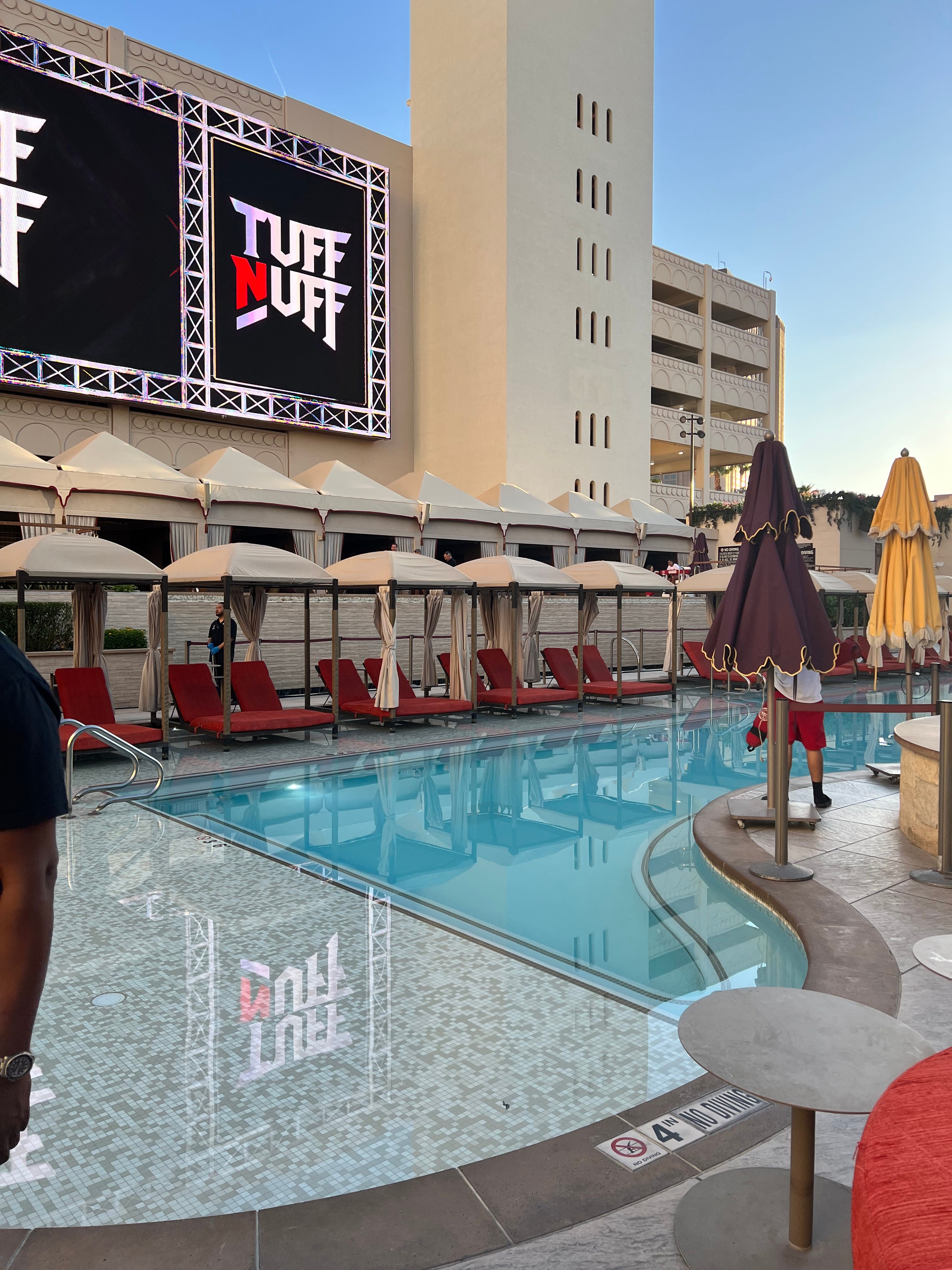
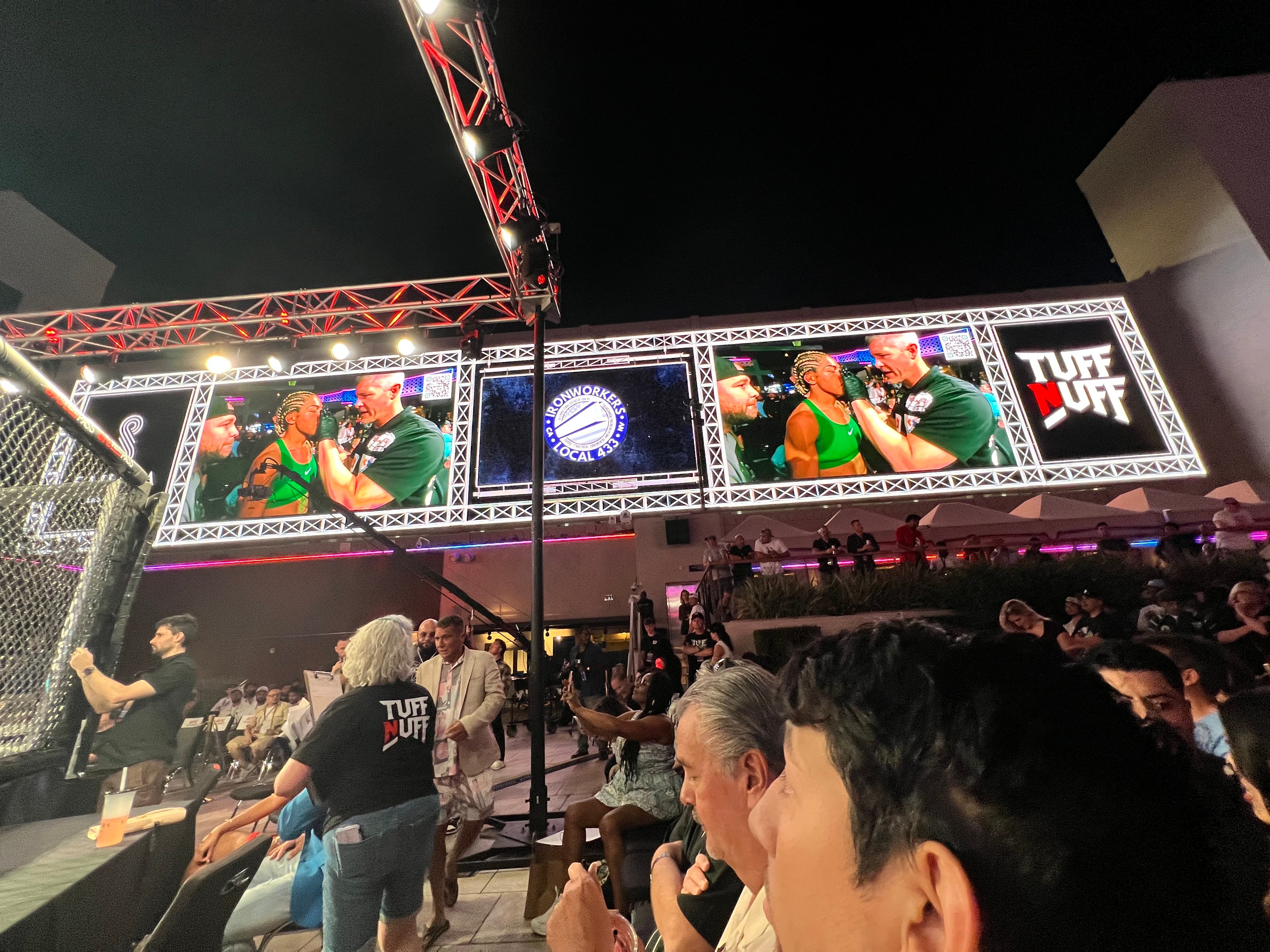
The venue is not full yet, though it will be later in the evening. The six-sided cage sits at the end of the pool near the doors to the casino and hotel, with rows of chairs pressed against four sides. General admission spectators stand behind the roped-off seating area or swim in the pool while watching the action on the 240-foot LED screen above. Daybeds and cabanas line the large rectangular pool, and the bar, twenty feet from the cage, is where guests go for refreshments. A $19 nonalcoholic piña colada in a souvenir Sahara cup nearly the length of my forearm will last me all night.
Two cameramen stand on perches flanking the cage, and a videographer and a photographer stand on two others. One more cameraman stays on the ground, shooting through the fence and filming the fighter walkouts.
The cutmen stand off to the side, ready to hop into action between rounds and after fights. Their vests, reminiscent of those worn by motorcycle club members, are covered in sponsor patches and branding from the likes of Cauliflower Culture and TheCutMan.com. One grizzled cutman wears his equipment like a soldier wears tactical gear, with Q-tips stuck in slots on the back of his wrist.
When the round horn blows, he rushes into the cage and directs the fighter on the stool to raise each arm in a mock strongman position and open his mouth, pantomiming the motions. When he exits roughly sixty seconds later, he tosses an Enswell, a metal tool used to reduce swelling, into a nearby ice bucket for its next use.
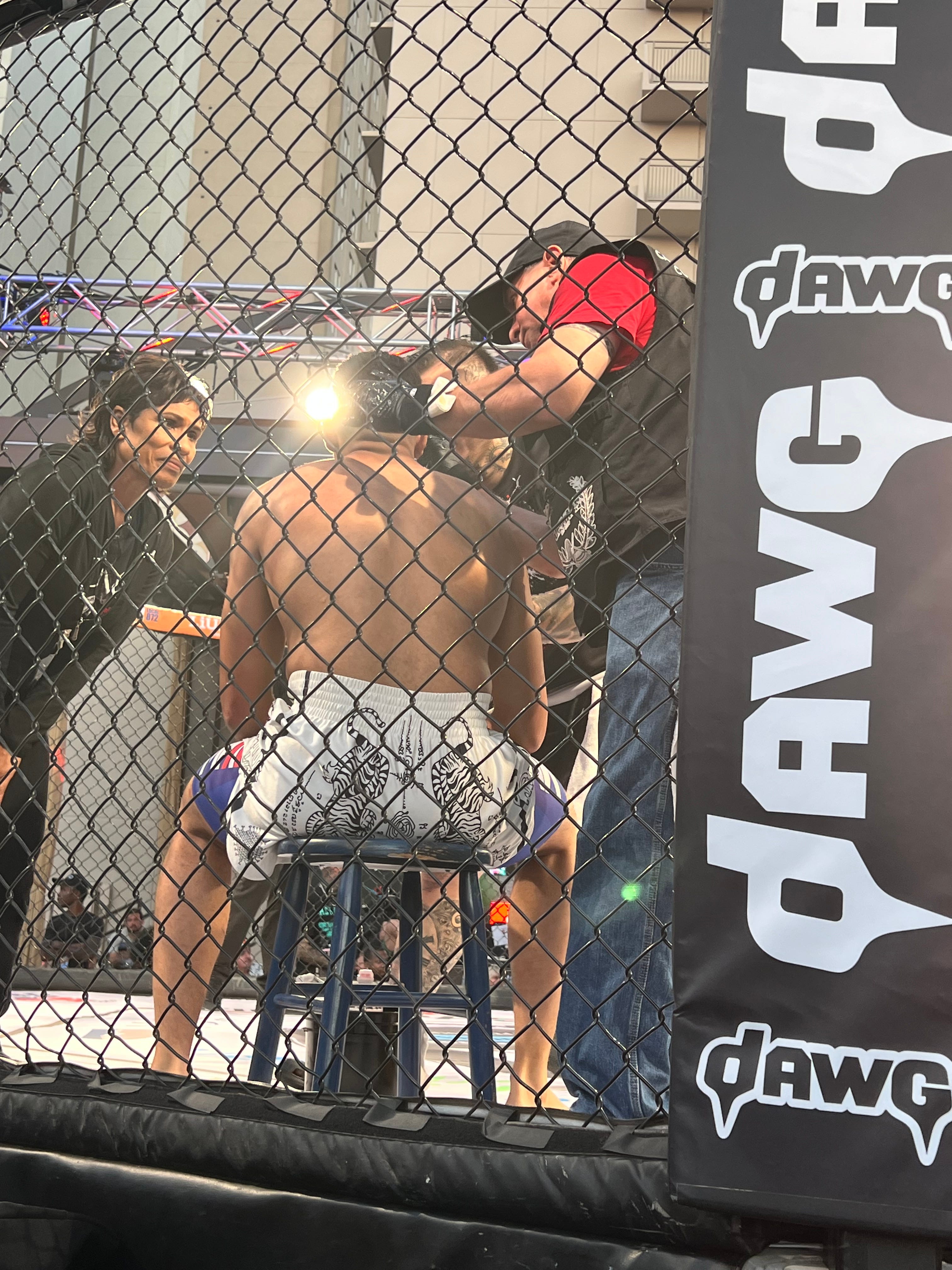
Before the first round of Juan Sarrios’s fight against Joseph Gomez, a cornerman pours water from a plastic bottle directly into Sarrios’s mouth through an opening in the cage fence. The corner sits directly to my left. During the fight, they yell commands using city codenames like “Phoenix” and “Tulsa.”
Gomez gets a takedown, but Sarrios returns to his feet and lands one of his own. When the fight looks like it’s going Sarrios’s way, his corner yells, “Finish it, he’s gone!”
Gomez endures, though Sarrios dominates the second round with wrestling and ground-and-pound. Gomez gets his own takedown in the third, but his corner wants more.
“You’re going to lose like this! Posture and punch!”
It doesn’t stop the exhausted-looking Gomez from lying on top of Sarrios for the rest of the round. Sarrios wins by unanimous decision.
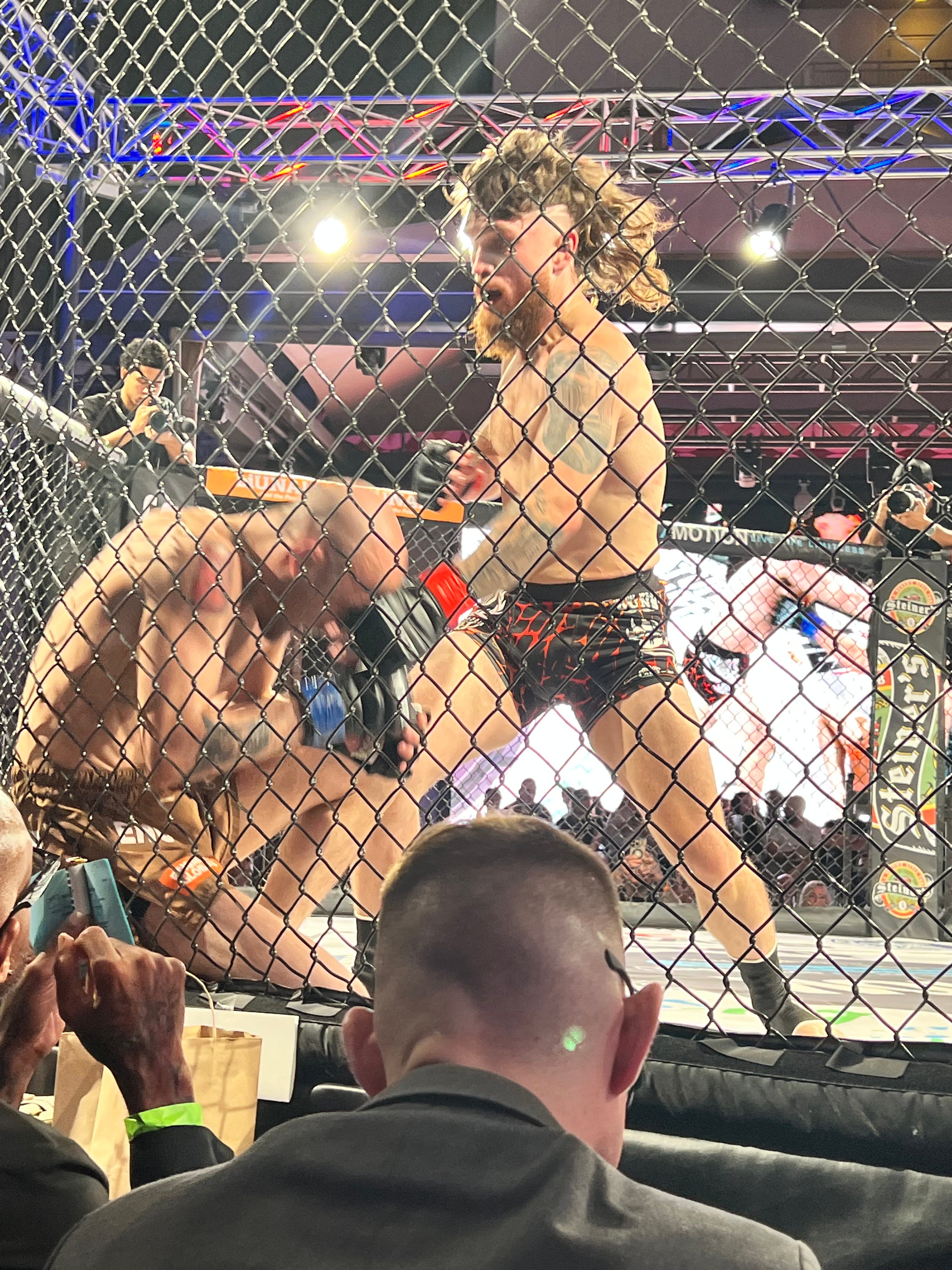
One of the referees for the amateur fights sits directly in front of me, which allows for conversation. He tells me he works with ISKA, the International Sport Kickboxing Association, and rotates bouts with another referee.
When lightweight Derek Rayfield scores an eight-second, one-punch KO over Oliver Moeckel, I jokingly ask whether that even counts as a match. The ref tells his reffing partner, in the same tone, that I said he should stay in there for another one.
The amateur women’s featherweight championship, between 2-0 Ashley Green and aptly-named 4-2 Skyler Thrasher, is scheduled for five three-minute rounds. Thrasher is covered in tattoos, including an AK-47 across her stomach. During the fight, her corner calls for knees. Each time, she answers with a hard thrust into her opponent’s midsection and a primal yell. Green gives knees back as good as she takes them, but Thrasher gets the TKO.
Outside the cage, another kind of apprenticeship is underway. I meet a judge-in-training who tells me he shadows a working judge. They each fill out a scorecard for a fight, and the judge then compares the two cards to see how the apprentice did.
The young man wears a crisp, well-tailored suit, but I notice his cauliflower ears.
“You must have been a fighter,” I say.
He confirms it. When a fight ends, the judge hands his scorecard to his apprentice, who runs it over so the score can be called out.
By the main card, the pool deck is packed. The fights switch to professional matches, and the referee pair from the amateur bouts is replaced by a different pair. I recognize the new referees from the UFC.
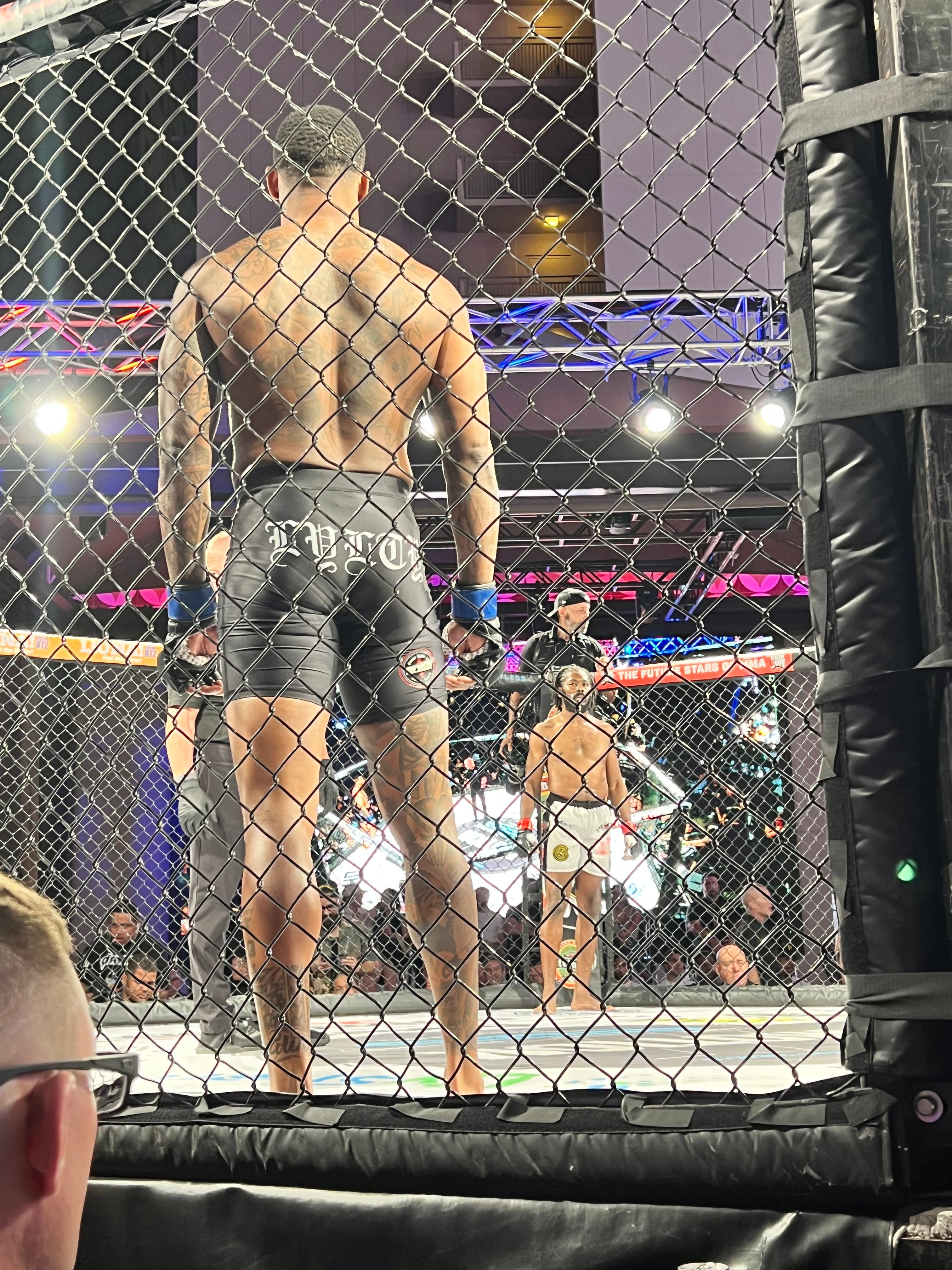
In the first professional match, between light heavyweights Hadxian King and Taz Stevenson, I hear people behind me discussing who they are cheering for.
“He’s going for the spiritual one that meditated,” one woman says.
The “spiritual one,” King, starts the match sitting cross-legged in his corner. At 3:23 of the first round, the Las Vegas fighter wins by submission in his professional debut.
At some point, the air around the pool cools enough that I stop noticing the weather. To my right, a section of chairs is labeled “UFC Fight Pass,” and I spot a few UFC fighters among the guests.
When bantamweight Zane Finley takes on Marco Martinez, UFC fighter Chase Hooper works in Martinez’s corner. After a competitive first round, Finley begins to take over in the second and wins by TKO due to elbows. Finley celebrates with elbowing motions as Hooper and the rest of Martinez’s cornering crew enter the cage looking disappointed.
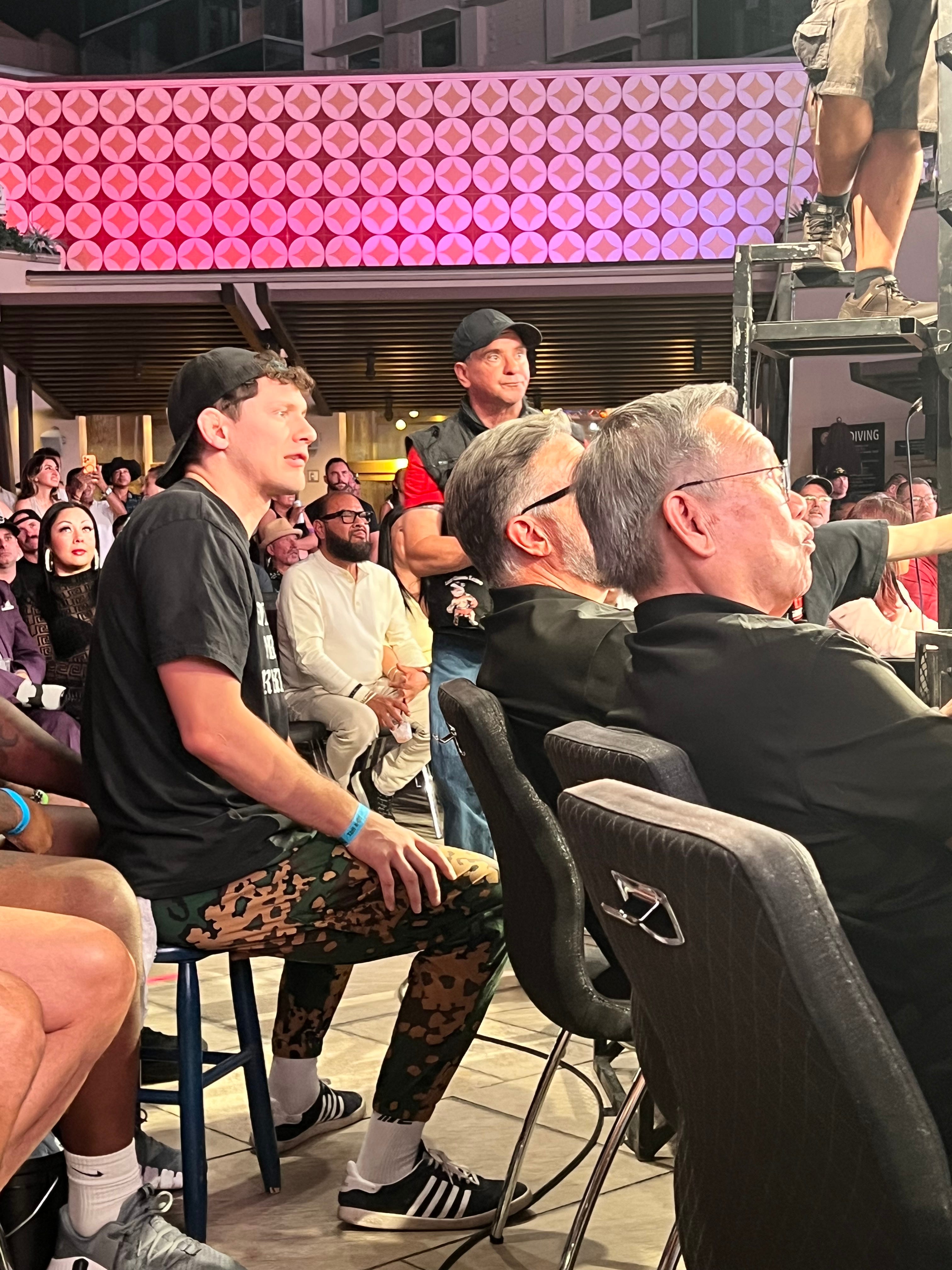
At some point, Aljamain Sterling sits in the empty chair next to me to observe the action.
Jeff Meyer, CEO and owner of Tuff-N-Uff, walks around throughout the night. He wears a pastel Vegas-themed button-down and matching shorts with the UFC logo emblazoned on them, plus sandals, an outfit that looks made for lounging poolside at a cabana. Over it all, he wears a blazer. He is a professional, after all.
He has championship belts to hand out.
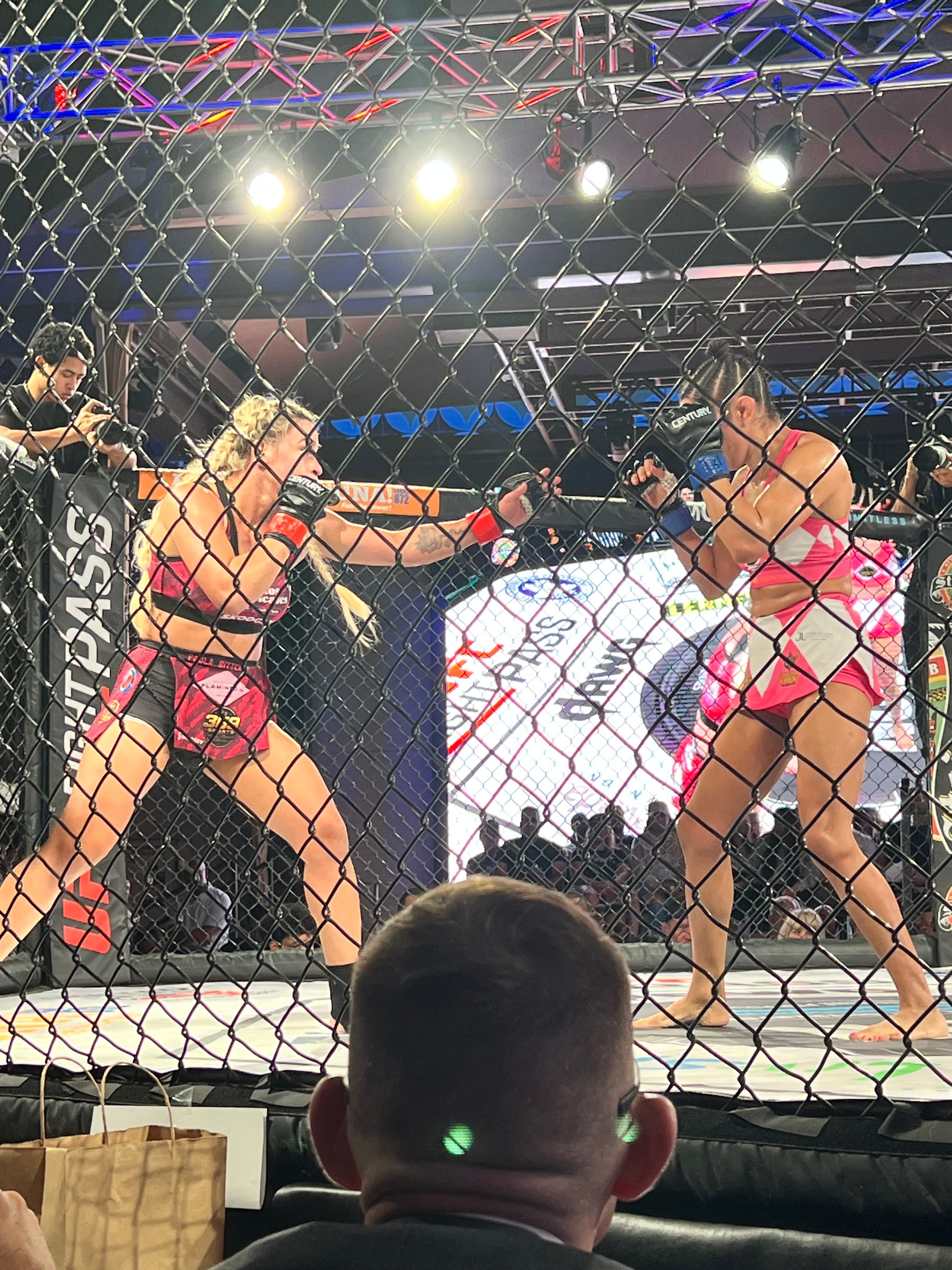
The professional women’s flyweight championship is between Paula Bittencourt and Rainn Guerrero. Guerrero comes out looking like the Pink Ranger, while Bittencourt also wears a not-insignificant amount of pink. The first round consists of heavy grappling against the cage. Bittencourt’s bleached-blonde hair is tied into two long, valkyrie-style braids, which grow increasingly frazzled as the fight drags on.
The fight goes the distance, and the majority decision goes to Bittencourt. Meyer climbs into the cage with the belt wrapped in plastic and strips off the wrapping before awarding it to the winner.
The final fight of the night is the world flyweight championship main event between Devon Jackson and Israel Galvan. Galvan steps into the cage with his buzzed head dyed pink with black polka dots. When the round begins, both fighters throw hard, and Galvan scores a KO at 1:44 of the first round.
Meyer again steps into the cage to award a belt to the winner. In his cage interview, Galvan calls attention to Jackson’s win over Joshua Van. He also calls out the UFC matchmakers, telling them he is ready for the big show.
At the end of the event, Meyer steps out of the cage, rips off his blazer, and flings it to his assistant standing next to me. They both laugh. He looks 100% ready to jump onto a pool floatie now.
At the afterparty, I catch Galvan and ask for a quick interview. He agrees.
“It felt great to hurt my fist on someone’s face,” he tells me.
“When someone gets hit by my power, it’s just different.”
He continues: “For flyweight, I hit hard, and everyone knows that. When someone isn’t on the level as mine is, it’s just going to be quick.”
When I speak to Jackson after the fight, he admits he should have tried to take Galvan down but thought he could get it done on the feet.
UFC matchmaker Sean Shelby walks by. He’s often seen at events sporting a Golden Knights hat.
“I’m sorry about the Etsy witch curse I placed on the Golden Knights last season,” I, a Sharks fan, tell him.
His companion, not missing a beat: “That was you?”
The next night, at the Meta APEX for UFC Vegas 121: Rosas Jr. vs. Barcelos, I run into Israel “El Huracán” Galvan. The now 11-3 fighter is standing in the lobby with the championship belt slung over his shoulder, his group surrounding him and chatting animatedly. Less than twenty-four hours after telling the UFC matchmakers he is ready, he has brought his new belt to their building. Now he wants a place in their cage.